

"Destroying rainforest for economic gain is like burning a Renaissance painting to cook a meal."
Edward O. Wilson (An American biologist, researcher, theorist, naturalist and author).
Edward O. Wilson (An American biologist, researcher, theorist, naturalist and author).
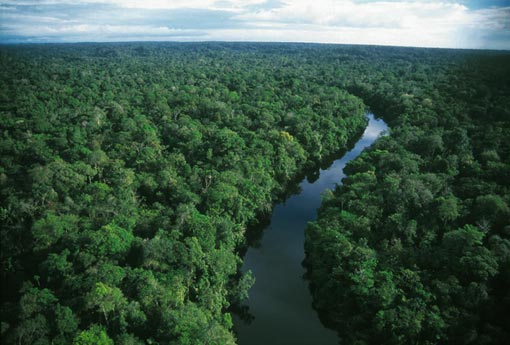
About the Rainforests...
Rainforest Amazon are forests characterized by high rainfall, with definitions based on a
minimum normal annual rainfall of 1750-2000 mm (68-78 inches. The
monsoon trough, alternatively known as the inter tropical convergence
zone, plays a significant role in creating the climatic conditions
necessary for the Earth's tropical rainforests.


Around
40% to 75% of all biotic species are indigenous to the rainforests and
it has been estimated that there may be many millions of species of
plants, insects and microorganisms still undiscovered in tropical
rainforests. Tropical rainforests have been called the "jewels of the
Earth" and the "world's largest pharmacy", because over one quarter of
natural medicines have been discovered there. Rainforests are also
responsible for 28% of the world's oxygen turnover, sometimes misnamed
oxygen production, processing it through photosynthesis from carbon
dioxide and consuming it through respiration.
The
undergrowth in some areas of a rainforest can be restricted by poor
penetration of sunlight to ground level. If the leaf canopy is destroyed
or thinned, the ground beneath is soon colonized by a dense, tangled
growth of vines, shrubs and small trees, called a jungle. There are two
types of rainforest, tropical rainforest and temperate rainforest.
Flora and Fauna...
More than
half of the world's species of plants and animals are found in the
rainforest. Rainforests support a very broad array of fauna, including
mammals, reptiles, birds and invertebrates. Mammals may include
primates, felids and other families. Reptiles include snakes, turtles,
chameleons and other families; while birds include such families as
vangidae and Cuculidae. Dozens of families of invertebrates are found in
rainforests. Fungi are also very common in rainforest areas as they can
feed on the decomposing remains of plants and animals. Many rainforest
species are rapidly disappearing due to deforestation, habitat loss and
pollution of the atmosphere.
Deforestation hampering the wild beauty...
Now,
coming to the horrifying fact that tropical and temperate rainforests
have been subjected to heavy logging and agricultural clearance
throughout the 20th century and the area covered by rainforests around
the world is shrinking.
Moreover,
Biologists have estimated that large numbers of species are being
driven to extinction (possibly more than 50,000 a year; at that rate,
says E. O. Wilson of Harvard University, a quarter or more of all
species on Earth could be exterminated within 50 years) due to the
removal of habitat with destruction of the rainforests. Another factor
causing the loss of rainforest is expanding urban areas.
Littoral
rainforest growing along coastal areas of eastern Australia is now rare
due to ribbon development to accommodate the demand for sea change
lifestyles. The forests are being destroyed at a rapid pace. Almost 90%
of West Africa's rainforest has been destroyed. Since the arrival of
humans 2000 years ago, Madagascar has lost two thirds of its original
rainforest. Likewise at present rates, tropical rainforests in Indonesia
would be logged out in 10 years and Papua New Guinea in 13 to 16 years.
According
to Rainforest Rescue, a main reason for the increasing deforestation
rate especially in Indonesia is the expansion of oil palm plantations to
meet the growing demand for cheap vegetable fats and bio fuels. In
Indonesia, palm oil is already cultivated on nine million hectares and,
together with Malaysia, the island nation produces about 85 percent of
the world’s palm oil.
Several
countries, notably Brazil, have declared their deforestation a national
emergency. Amazon deforestation jumped by 69% in 2008 compared to 2007's
twelve months, according to official government data. In fact,
Deforestation could wipe out or severely damage nearly 60% of the Amazon Rainforest by 2030, says a new report from WWF.
However, a
January 30, 2009 New York Times article stated, "By one estimate, for
every acre of rain forest cut down each year, more than 50 acres of new
forest are growing in the tropics..." The new forest includes secondary
forest on former farmland and so-called degraded forest.
Sometimes wildness can be such exceptional beauty.... provided we let it remain wild forever!
AW:(Samrat Biswas)



No comments:
Post a Comment